
- Soziologie mit dem Schwerpunkt Kultur und Migration
- Prof. Dr. Encarnación Gutierréz
- Vita
- Wissenschaftliche Mitarbeiterinnen
- Humboldt Fellow
- PHD Supervision
- Publications
- Research & Engagement
- Team
- MeDiMi
- Lateinamerika Netzwerk - PluriSoLa
- 100 Years Fanon!
- Assesment
- B.A. & M.A. Abschlussarbeiten
- Teaching
- Current
- Vertretungsprof. Dr. Céline Aïssatou Barry
Lateinamerika Netzwerk
Speaker for the Potentialfeld:
Prof. Dr. Encarnación Gutiérrez Rodríguez and María Cárdenas, M.A., Sociology (FB 03)
Prof. Dr. Romana Radlwimmer, Romance Literature (FB 10).
The Latin America Network (LANW) is an association of established professors, junior professors, and ECRs at Goethe University Frankfurt, which was founded in 2023 to promote transdisciplinary research on Latin America. Since then, it has regularly organized events such as lectures and workshops. The LANW is part of Goethe University's Orders and Transformations profile area. The LANW members' research ties in with existing research projects and areas of potential within the profile area.
LASA International Congress; May 26 - 30, 2026
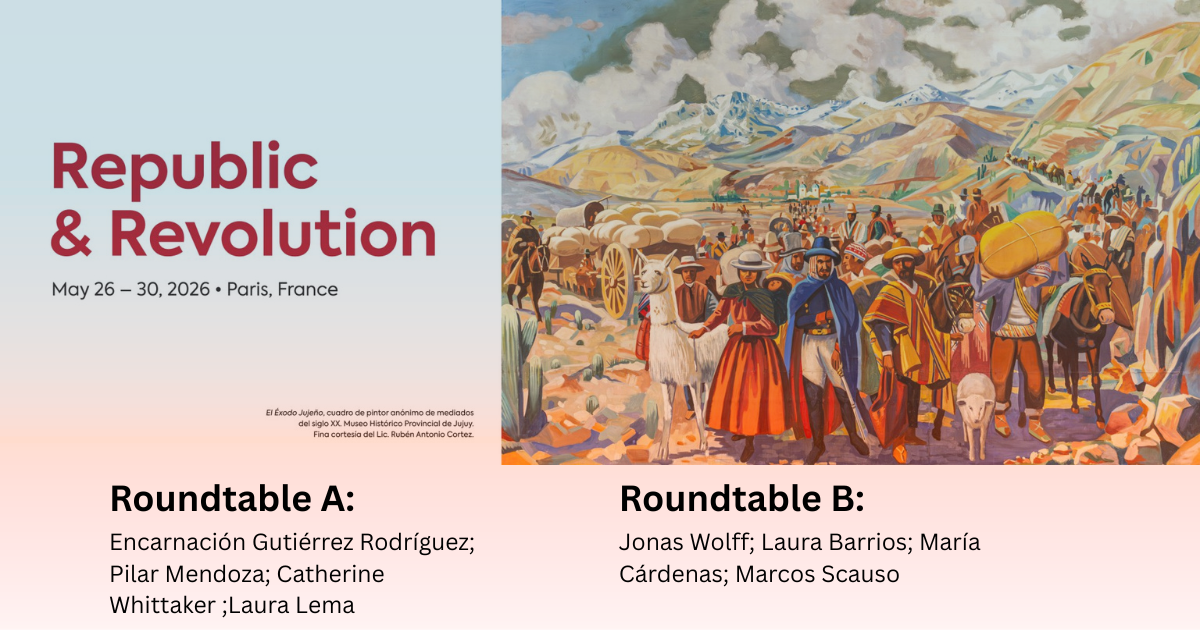
„Otros Saberes and Alternative Methods“: PluriVers presents their work on pluriversality in antagonistic societies - Learning from and with Abya Yala
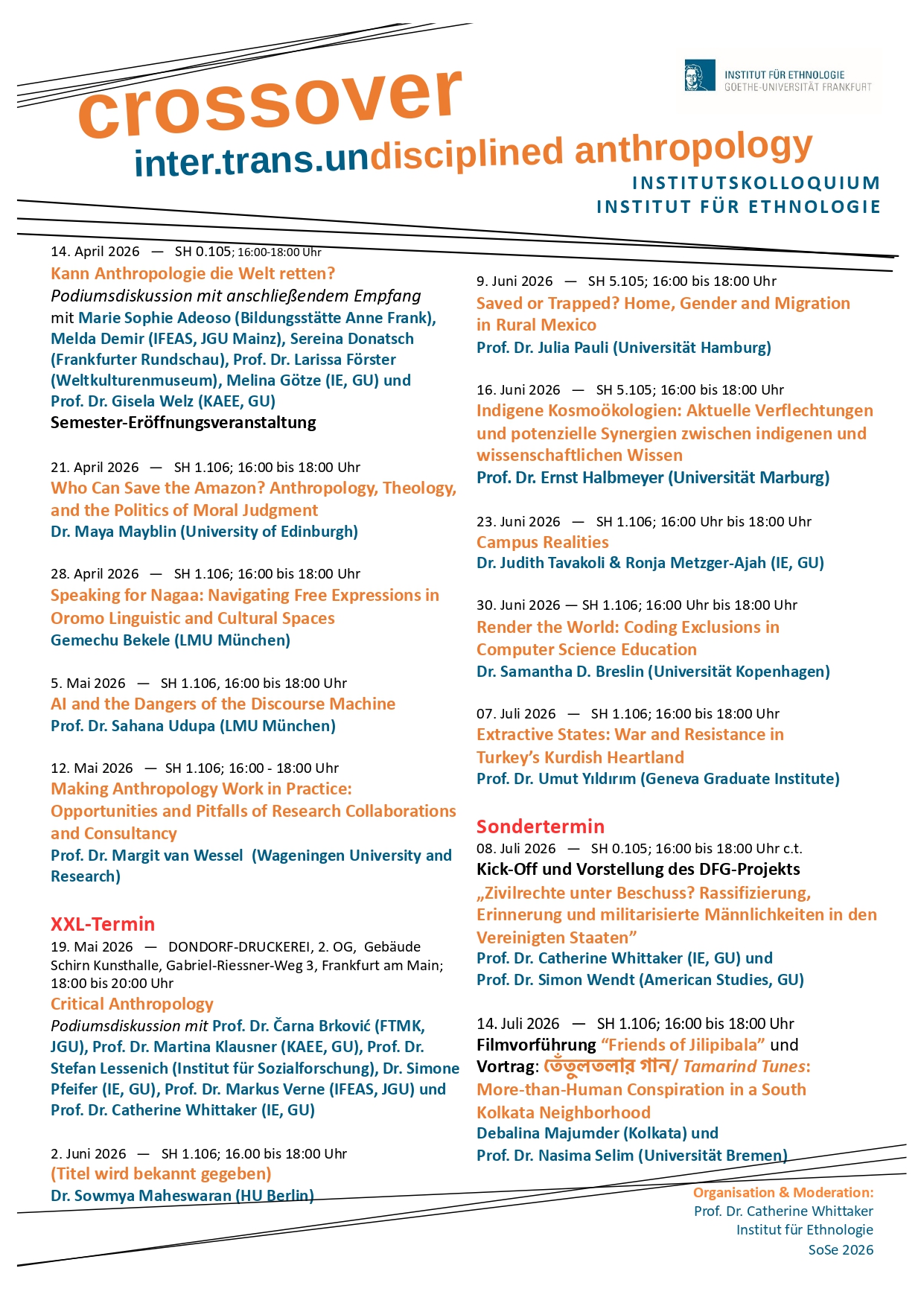
Recent activities - Lecture Series

Second session: “Ontological conflicts in the Colombian Caribbean: Divergent stakeholder classifications of the environment as a driver of conflict”.

In the second session of the lecture series, Markus Rauchecker presented on ontological conflicts in the Colombian Caribbean, focusing on a case study involving a water source in El Morro. His core argument is that diverging ontologies—fundamentally different understandings of what “nature” is – significantly drive environmental conflicts.
Three main actors were analysed: the local (indigenous) community, construction companies, and state institutions. While state and corporate stakeholders classify nature as a resource to be managed, exploited, or compensated for, the local communities regard it as the essential foundation of life. A water source not officially mapped was excluded from planning processes, demonstrating how certain worldviews are systematically disregarded.
Rauchecker advocated for expanding environmental conflict research to include ontological questions – how orders and classifications are formed in power-laden processes. He highlighted the contrast between Western dichotomies (nature vs. culture) and indigenous perspectives, stressing the political implications of excluding non-dominant ontologies.
The discussion addressed methodological challenges of capturing non-Western knowledge systems, the colonial nature of cartography, and the broader issue of how nature is socially constructed and contested:
Thrid Session: “El exilio colombiano como lugar simbólico, político y transiciónal”.

In the third session of the lecture series, Pilar Mendoza presented her research under the title “Colombian Exile as a Symbolic, Political, and Transitional Space.” Drawing from work at the Colombian National Centre for Historical Memory, Mendoza examined exile as a complex experience shaped by Colombia’s decades-long armed conflict, collective trauma, and systemic racism – especially against Indigenous and Afro-Colombian populations.
She highlighted how the categories of exile, migration, and asylum blur together, often deliberately manipulated by state policies to obscure international legal responsibilities toward displaced persons. Although Colombia signed a peace agreement in 2016 intended to end its internal armed conflict, the continued movement out of the country reflects the failed implementation of the accord – including unfulfilled guarantees of safety, justice, and social reintegration – as well as the persistence of violence and structural inequality. For Mendoza, exile is not merely a physical departure but a political and affective space: one shaped by resistance, memory, and the ongoing reconstruction of identity.
The presentation emphasized the crucial role of civil society, especially exiled communities, in peacebuilding and historical memory. Mendoza traced how community-based memory practices – often emerging on the margins – become central to broader national conversations on truth, justice, and reconciliation. She highlighted Colombia’s restorative justice model, which emphasizes symbolic reparation and includes strong participation by Indigenous and Afro-Colombian commissioners and magistrates.
Exile is framed as a threshold experience – marked by rupture, dislocation, and transformation – where individuals experience temporal dislocation and identity transformation. Concepts like “insilio” (internal exile), desarraigo (uprootedness), and circular time perceptions underscore the emotional and ontological complexity of exile. Mendoza called for a decolonial approach to peace and memory, recognizing the agency of marginalized communities and their diverse worldviews, practices, and epistemologies.
Fourth Session: “Pluriversale Sinnesgrenzen. Dekoloniale Bewegungen, migrantische Körper und Sinneserfahrungen an der US-mexikanische Grenze”.

In the fourth session of the lecture series, Catherine Whittaker and Elizabeth Schierhold presented their ongoing research project titled “Pluriversale Sinnesgrenzen. Dekoloniale Bewegungen, migrantische Körper und Sinneserfahrungen an der US mexikanischen Grenze.” The project explores how migrant and racialized individuals perceive borders through sensory experience, using the concept of sentipensar (thinking-feeling) as a decolonial epistemological tool.
The researchers apply a multisensory ethnographic approach in San Diego/San Ysidro, collaborating with local cultural institutions and activist networks. They analyse how sounds – along with other senses like touch and smell – shape the embodied experience of borders and contribute to processes of homemaking and belonging. The use of a Soundbox (a mobile affective artifact) allows participants to archive and share urban, natural, and domestic soundscapes, offering insight into memory, identity, and affective geographies.
Key theoretical frameworks include sound studies, the anthropology of the senses, affect theory, and decolonial pluriversality. Sound is not merely noise – it influences perception, emotion, and spatial attachment. Migrant homemaking is explored through acoustic practices, revealing how sonic experiences can both anchor and unsettle one’s sense of place.
The discussion touched on issues such as gentrification, the political dimension of sensory experiences, and the importance of Gloria Anzaldúa’s concept la facultad – a multisensory intuition vital for survival. Questions of memory, temporality, and the role of sound in producing or destabilizing a sense of "home" were also raised, along with a critique of colonial spatial dynamics in border zones.Fifth Session: “Thinking pluriversal proteccion through rooted (and conventional) diplomacy networks”.

On May 28, María Cárdenas presented her past, ongoing, and future research exploring what we can learn from ancestral activists and their onto-epistemologies to rethink peace and security. A key part of her research engaged with ancestral activists' rooted (and conventional) diplomacy networks and their potential to envision and build a pluriversal form of protection as an alternative to the increasing normalization of armed violence. Building on her long-term engagement with Indigenous, Afro-Colombian, Raizal, Rrom, and Palenquero activists in Colombia, Cárdenas shared her doctoral research on the peace activism of ancestral activists in Colombia and how they used different diplomacy methods to secure the inclusion of an ethnic chapter in the agreement. Looking ahead to her current and future work, she discussed the need to rethink predominant approaches to peace and security. Eurocentric security models, such as the survivalist ethos of hegemonic international politics (Graham and Brigg, 2023), are limited in addressing the challenges of modernity/coloniality (Escobar, 2018). Learning from ancestral communities in Colombia, alternative practices are available for reimagining peace and security within a pluriverse. However, local responses (i.e. Guardias) are increasingly threatened in their possibilities to confront extractivist and ontological violence and erasure on the ground. Therefore, ancestral activists aim to transcend the boundaries imposed by coloniality—such as territorial, national, and regional borders—and make an impact on the global stage through rooted and traditional diplomacy networks. Accompanying these activists and their networks in her ongoing and future research, Cárdenas' research contributes to ongoing debates on the global relevance of ancestral actors in peace and security governance, while exposing the limits of hegemonic international security paradigms.
For further information, see:
Cárdenas, M. (forthcoming): On Pluriversality and Governance: Decolonizing Lessons from Colombia. International Affairs.
Cárdenas, M. (2025). Learning From the “Guardias” Integral Security as a Response to Multiple Phenomena of Violence in Colombia (C. Schweitzer, Ed.; pp. 35–40). Bund für Soziale Verteidigung e.V. https://soziale-verteidigung.de/wp-content/uploads/2025/02/HuD-87-Social-Defence.pdf
Cárdenas, M. (2023): Why peacebuilding is condemned to fail if it ignores ethnicization. The case of Colombia. Peacebuilding. DOI: 10.1080/21647259.2022.2128583
Sixth Session: “Lecturas contestatarias del tiempo histórico. Transmedialidad e imaginación para la construcción de ordenes alternativos”.

Laura Barrios and Jonas Wolff presented findings from their research on post-conflict reintegration of ex-FARC-EP combatants in Colombia, examining how collective reincorporation affects social cohesion and perceptions of peace. Drawing on intergroup contact theory, survey data revealed that close interaction with former combatants led to reduced social distance and increased support for political reintegration and peace processes.
They also introduced their ongoing project on pluriversal peacebuilding, emphasizing the diverse, often conflicting interpretations of peace, justice, and development across local actors. Using feminist and decolonial participatory methods – especially social cartography and body mapping – the researchers aim to co-produce knowledge with communities while addressing gendered and epistemological complexities.
Key themes included: 1). The gap between the peace agreement's collective ideals and lived experiences. 2). Tensions around gender, heteronormativity, and community identities. 3). Methodological challenges in balancing flexibility, representation, and ethical engagement. 4). The need to recognize diverse ontologies and avoid imposing homogeneous interpretations of peace
The discussion highlighted issues of methodological reflexivity, the limitations of psychological frameworks, and the value of centring community agency in peacebuilding research.Seventh Session: “The Rights of Other-than-human-beings. Our Responsibility with Regard to the Beings Around Us”.

Recent events
Friedensaufbau in Kolumbien: Stimmen aus den Territorien.
Das Instituto Cervantes Frankfurt organisiert in Zusammenarbeit mit dem Leibniz-Institut für Friedens- und Konfliktforschung ein Kolloquium, das sich den territorialen und ökologischen Kämpfen in Konfliktkontexten widmet. Im Mittelpunkt der Veranstaltung steht Jani Silva, soziale Aktivistin aus Putumayo, Kolumbien, und Trägerin des Hessischen Friedenspreises 2024.

Departments, institutes, and members involved
Goethe University departments and institutes involved:
- FB 03: Department of Social Sciences
- FB 08: Philosophy and History
- FB 10: Modern Languages
- FB 11: Institute of Human Geography
Prof. Dr. Encarnación Gutiérrez Rodríguez - Prof. Dr. Susanne Heeg
- Prof. Dr. Romana Radlwimmer
- Prof. Dr. Roland Spiller
- Prof. Dr. Catherine Whittaker
- Prof. Dr. Jonas Wolff
- Dr. Pilar Mendoza
- María Cárdenas, M.A.
- Laura Camila Barrios Sabogal
Some of its members cooperate with or are affiliated to the Institute for Social Research (IfS), the Peace Research Institute Frankfurt (PRIF), and the Cornelia Goethe Center (CGC).
Prof. Encarnación Gutiérrez Rodríguez

Encarnación Gutiérrez Rodríguez is a Professor in Sociology with a focus on Culture and Migration at the Goethe University, Frankfurt/Main. Previously to this position, she was Professor in General Sociology at the Justus-Liebig-University Giessen. Moreover, she is an Adjunct Professor in Sociology at the University of Alberta, Canada, and Visiting Professor in CRISHET – Chair for Critical Studies in Higher Education Transformation, Nelson Mandela University, South Africa. In 2020/21, she was a Digital Senior Fellow in Maria Sibylla Merian Centre: Conviviality-Inequality in Latin America (Mecila), São Paulo. She has been an early and staunch advocate of decolonial critique in the German-speaking world. Her research focuses on coloniality of migration, social reproduction and care, decolonial feminist and critical theory in Europe, the Caribbean and Abya Yala.
Prof. Romana Radlwimmer

Romana Radlwimmer is a Professor of Romance Literatures and Cultures at Goethe University Frankfurt. Her research focuses on transoceanic connections between the Iberian Peninsula, the Americas, and the Romance world. She is the editor of the De Gruyter series Romance Literatures and Cultures in Colonial Continuity and the director of the VW-funded projects Pandemics and Coloniality (2021-23) and Archives of Colonial Dis/Possession (15th-18th Centuries) (2024-25).
Prof. Catherine Whittaker

Catherine Whittaker is an Assistant Professor and current Chair of the Institute of Social and Cultural Anthropology at the Goethe University Frankfurt. She studies security, militarization, and structural violence in Latin America (esp. Central Mexico) and the U.S.-Mexico border region, based on feminist, Indigenous, and decolonial theory and methods. Her most important publications include the monographs Watchful Lives in the U.S.-Mexico Borderlands and Becoming Vigilant Subjects as well as the article "Beyond the Dead Zone: The Meanings of Loving Violence in Highland Mexico" (all 2023).
Prof. Jonas Wolff

Jonas Wolff is professor of political science with a focus on transformation studies and Latin America at Goethe University Frankfurt as well as executive board member and head of the research department “Intrastate Conflict” at the Peace Research Institute Frankfurt (PRIF). His research focuses on the transformation of political orders, contentious politics, political violence, international democracy promotion, and Latin American politics. Recent publications include Business Power and the State in the Central Andes (University of Pittsburgh Press, 2023, co-authored with J Crabtree and F Durand; Spanish version: Estado y poder empresarial en Bolivia, Ecuador y Perú, Fondo Editorial de la PUCP, Plural y Abya-Yala, 2024) and Socioeconomic Protests in MENA and Latin America (Palgrave Macmillan, 2020, co-edited with I Weipert-Fenner). He is governing board member of the Instituto Colombo-Alemán para la Paz (CAPAZ) and co-speaker of the research center “Transformations of Political Violence” (TraCe).
Prof. Susanne Heeg

Susanne Heeg's research focuses on collaborative strategies in urban development. She has studied how participation is integrated into the material and social construction of cities, as well as the actors and power dynamics that shape the built environment. In Mexico, she conducted research on the increasing financialization of the housing sector since 1990.
Dr. Pilar Mendoza
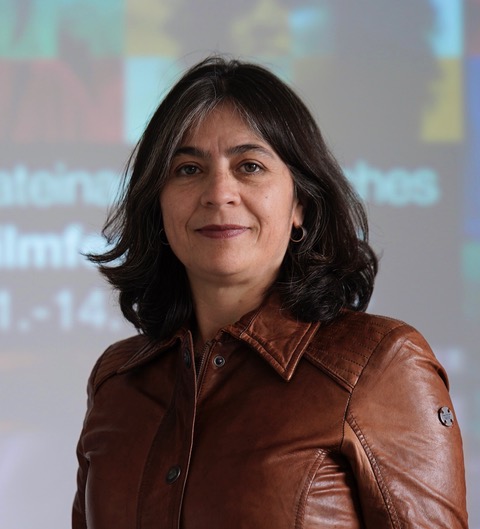
Dr. Pilar Mendoza has a PhD and Master's degree in Sociology from the École des Hautes Études en Sciences Sociales in Paris and Communications Scientist from the Universidad Central de Colombia. Researcher specializing in Colombia and Latin America in the fields of social inequality, migration, exile, and forced displacement, peace and conflict studies, and “memoria" (coming to terms with the past) from an interdisciplinary perspective.
Dr. María Cárdenas

María Cárdenas, peace and conflict researcher, completed her doctoral thesis in sociology (Dr. Phil) at Justus Liebig University Giessen in 2025. In her thesis, she examined the potential of indigenous and Afro-Colombian activism for decolonizing the Colombian peace process and building pluriversal peacebuilding. Her focus on Latin America includes decolonial perspectives, interethnic peace perspectives, and conflict.
Laura Camila Barrios Sabogal

Laura Camila Barrios Sabogal: PhD candidate at the Leibniz Peace Research Institute Frankfurt (PRIF) and Goethe University Frankfurt. Her research focuses on the reintegration of former combatants and local peace processes in Colombia from a gender and security perspective.
Affiliates
Thomas Duve ist Professor für vergleichende Rechtsgeschichte an
der Goethe-Universität Frankfurt am Main und Direktor am Max-Planck-Institut
für Rechtsgeschichte und Rechtstheorie. Zuvor lehrte und forschte er
unter anderem in München und Buenos Aires mit Schwerpunkten in
Rechtsgeschichte, Kirchenrecht und Rechtsphilosophie. sekduve@lhlt.mpg.de
Pedro Monteiro ist wissenschaftlicher
Mitarbeiter an der Goethe-Universität Frankfurt am Main und forscht zu
lusophoner und hispanischer Literatur und Kultur. 2025 veröffentlichte er sein
erstes Buch zu iberischen Ritterromanen des 16. Jahrhunderts und arbeitet
derzeit an einem neuen Projekt zu zeitgenössischen lateinamerikanischen queeren
Romanen. monteirosantos@em.uni-frankfurt.de
Elizabeth Schierhold. Institute of Social and Cultural Anthropology at the Goethe University Frankfurt.
Markus Rauchecker ist wissenschaftlicher
Mitarbeiter am Institut für sozial-ökologische Forschung. Er befasst sich mit
Umweltgovernance und Umweltkonflikten zwischen Stakeholdern in den
Themenbereichen (transgene) Landwirtschaft, Landnutzung und Biodiversität. markus.rauchecker@isoe.de
Karla Escobar ist Koordinatorin für kollaborative Forschung
im Bereich „Knowledge Systems and Collective Life“ am Max-Planck-Institut (MPI)
Berlin. Sie war am MPI für Rechtsgeschichte und Rechtstheorie tätig, wo sie unter anderem das
Projekt „Transmedia HistoryTelling“ zur Verbindung von Geschichtsforschung mit
Comics, Video und Muralkunst entwickelte. kescobarh@mpiwg-berlin.mpg.de
Steven Gonzalez Monserrate ist Postdoktorand am Forschungsprogramm
„Fixing Futures“ der Goethe-Universität Frankfurt am Main, wo er
Dateninfrastrukturen als „technologies of anticipation“ untersucht. S.Gonzalez@em.uni-frankfurt.de
Betânia Ramos Schröder ist eine
afrobrasilianische Schriftstellerin, Soziologin und unabhängige Forscherin mit
Erfahrungen in der internationalen Zusammenarbeit, kommunalen Politik sowie in
transnationalen Bildungs- und Kulturprojekten zwischen Brasilien und
Deutschland. Ihre Arbeit beschäftigt sich mit Migration, Afrodiaspora,
Erinnerung, Exil und Kolonialität und verbindet wissenschaftliche Reflexion mit
literarischer Sprache und gesellschaftspolitischer Praxis. Sie ist unter
anderem Mitglied von BrasilNilê e.V. und Kooperation Brasilien e.V. betania_ramos.schroeder@mail.de
Ana Graça Wittkoviski ist Gründerin des
deutsch-brasilianischen Kulturvereins BrasilNilê e.V. und arbeitet als
interkulturelle pädagogische Fachkraft, Elternbegleiterin/beraterin und
Referentin zu Kolonialismus und Diskriminierung. mailto:anagracawittkowski@yahoo.de
Yolima Vargas ist promovierte Doktorin der Erziehungswissenschaften an der Universität
Salamanca. Ihre Forschung konzentriert sich auf die Analyse der Auswirkungen
von Kolonialisierung und des Entwicklungsparadigmas auf die Verschlechterung
der Beziehung zwischen Gesellschaft und Natur. In Frankfurt am Main arbeitet
sie für das Projekt House of Resources Rhein-Main beim Deutsch-Indische
Zusammenarbeit e. V. und ist außerdem als Referentin zu den Themen Globales
Lernen und Umweltbildung tätig . vargas@diz-ev.de
Iván Barbaric koordiniert
die Lateinamerikanische Woche in Frankfurt, die immer im Herbst am Campus Westend
stattfindet. ivanbarbaric@hotmail.com
Marilu Huertas de
Schneider ist eine
Mitarbeiterin der Abteilung Didaktik der Biowissenschaften und Zootierbiologie
an der Goethe-Universität Frankfurt. marilu.huertasschneider@yahoo.de
Alejandro Pedrón arbeitet beim epn
Hessen e.V., wo er die Zusammenarbeit und Vernetzung von Migrant:innen- und
Diasporaorganisationen in Hessen stärkt, Projekte im Bereich
Entwicklungspolitik und SDGs unterstützt sowie Workshops und Netzwerktreffen
koordiniert. alejandro.pedron@projektmoses.de
Fernando Ortega ist Jurist und promovierter Dr. iur. an der Johannes-Gutenberg-Universität Mainz. Im Jahr 2019 nahm er an der „Masterclass“ des Max-Planck-Instituts (MPI) für öffentliches Recht und vergleichendes Völkerrecht in Heidelberg teil. Er ist Mitglied der Deutsch-Kolumbianischen Juristenvereinigung („ACAJ/DKJV“) und der Republikanischen Anwaltsvereinigung („RAV“). Als Mitbegründer der Initiative „Recht auf Asyl“ (derechoalasilo.de) arbeitet er seit 2019 im Bereich Asyl, Flucht und Migration und bietet Unterstützung für gefluchtete aus Lateinamerika. fernando.ortega@posteo.de
Associates
Tania Camila Triana Cuevas is a PhD candidate
at the Institute for Romance Languages and Literatures at Goethe University
Frankfurt and a doctoral scholarship holder of KAAD. Her research focuses on
memory, forced disappearance, transgenerational transmission, violence, and
historical reckoning in Latin America, with particular attention to Chile and
Colombia. In her dissertation, she examines processes of memorialization around
forced disappearance by bringing literary narratives and truth commission
reports into dialogue. Beyond her academic work, she has experience as a
consultant in projects on peacebuilding, human rights, historical memory, and
conflict transformation in Colombia. TrianaCuevas@em.uni-frankfurt.de
Julio Cáceda ist Dozent am Fachbereich Geisteswissenschaften und promovierter Politikwissenschaftler der Goethe-Universität Frankfurt am Main mit Forschungsschwerpunkten in Gerechtigkeit und Freiheit im Capability Approach sowie in der Kritischen Theorie. julioa.caceda@pucp.pe
Previous events
- Dank der Förderung durch den PB OT wurde der Workshop „Gesellschaftstheoretische und kulturkritische Transformationsprozesse in Latein Amerika / Abya Yala“ (14.-15.12.2023) organisiert, an dem Prof. Dr. Sérgio Costa (Soziologie, FU Berlin), Prof. Dr. Julia Roth (Amerikanistik, Uni Bielefeld) und Prof. Dr. Kirsten Mahlke (Kulturwissenschaft/Romanistik, Uni Konstanz) als Gastvortragende teilnahmen.







- Presse & Kommunikation
- Pressemitteilungen
- Öffentliche Veranstaltungen
- Uni-Publikationen
- Aktuelles Jahrbuch
- UniReport
- Forschung Frankfurt
- Karriere & Jobs
- Frankfurter Kinder-Uni
- Zahlen und Fakten
- Internationales
- Inbound: Aus der Welt nach Frankfurt
- Outbound: Von Frankfurt in die Welt
- Erasmus / LLP
- Goethe Welcome Centre (GWC)
- Refugees / Geflüchtete
- Erasmus +
- Sprachenzentrum oder Fremdsprachen
- Goethe Research Academy for Early Career Researchers
- Forschung
- Research Support
- Wissenschaftliche Zentren
- Unser Forschungsprofil
- Forschungsförderung
- Infrastrukturzentren
- Promovierende & Postdocs