​​​​​

logo-fb03-1

Schwerpunkt Methoden der Qualitativen Empirischen Sozialforschung

Aktuelles

Profilbild Anna Geyer
Profilbild Claudius Wagemann
Profilbild Noah Weber

New INTERFACED Report: Democracy and Science Sceptic Mobilisations in Europe and Beyond

The INTERFACED consortium's Frankfurt team Anna Geyer, Noah Weber and Claudius Wagemann - responsible for Work Package 7 - has submitted its latest report, Deliverable D7.2, providing a comprehensive analysis of mobilisations that challenge liberal democracy and scientific expertise across seven countries (Austria, Denmark, Germany, Italy, Spain, Tunisia, and the United Kingdom) since 2020. This report marks a significant milestone as the INTERFACED project approaches its halfway point.

Key Findings and Focus Areas

The report examines how public health, immigration and multiculturalism, and environmental issues have become central drivers of democracy and science-sceptic mobilisations. It reveals a troubling trend: the increasing appropriation of such movements by far-right actors, posing intensified challenges to liberal-democratic norms and institutions. Furthermore, the COVID-19 pandemic has amplified science-sceptic mobilisation in all studied countries.

Comparative Analysis and Future Directions

By comparing mobilisations across these diverse contexts, the report offers valuable insights into the evolving landscape of political and scientific contestation. It concludes by identifying key areas for future research, setting the stage for more in-depth and comparative analysis of institutional responsiveness to these movements.


About INTERFACED

Launched in January 2025, the INTERFACED project is a collaborative effort to understand and address the “interfacing" between political participants and authority actors. The submission of D7.2 underscores the project's productivity and its commitment to delivering timely, evidence-based research.

Next Steps

Deliverable D7.2 will serve as a foundation for further comparative studies within the INTERFACED consortium, informing both academic discourse and policy responses to the challenges posed by democracy- and science-sceptic movements.


YouReAct_Berlin
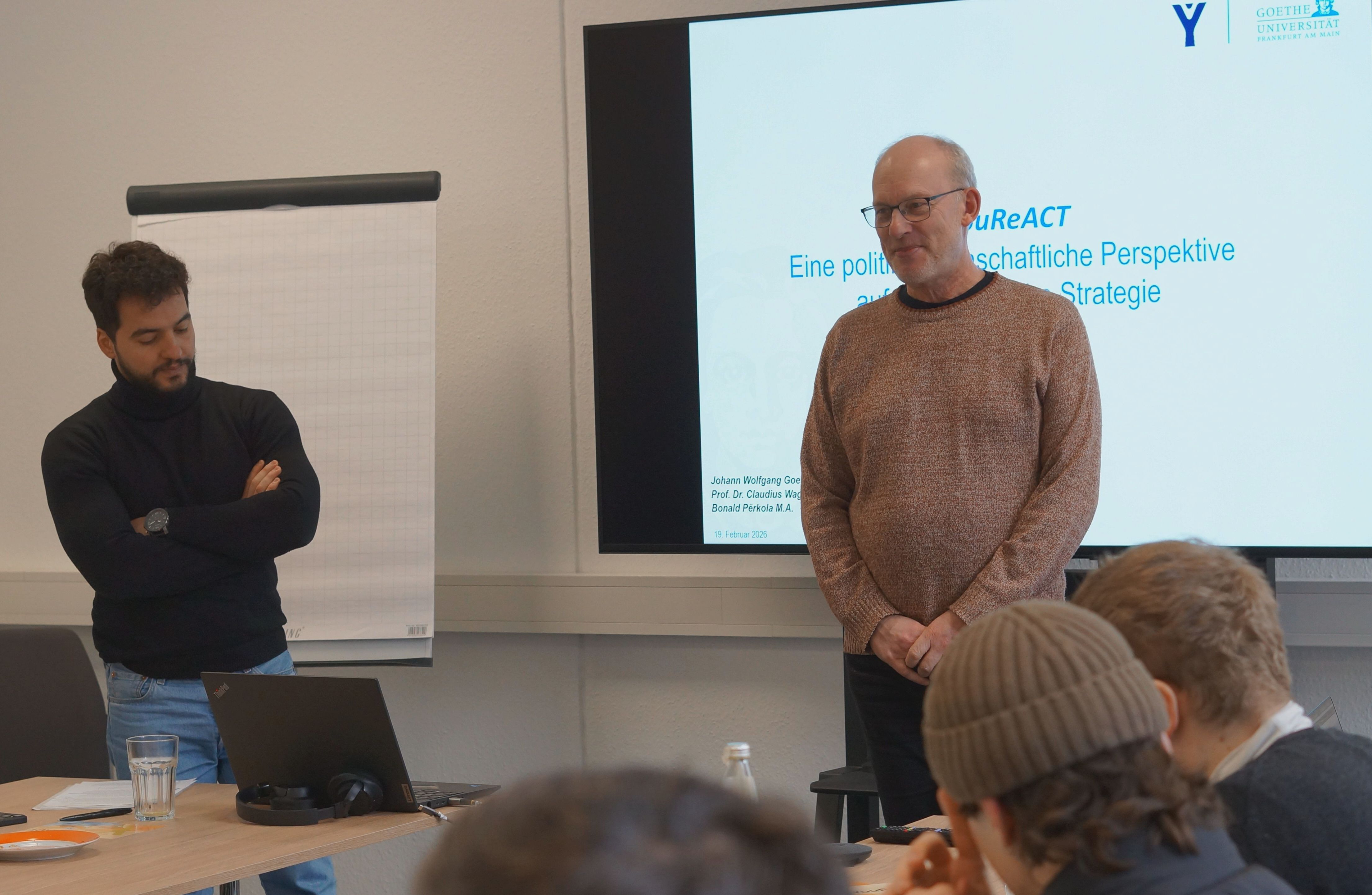
An der International Psychoanalytic University Berlin (IPU) fand am 18. und 19. Februar 2026 - also noch mitten im berühmt-berüchtigten Berlinwinter - das zweite YouReACT-Projekttreffen statt. Nach einer kurzen Begrüßung der beiden auswärtigen Forschungsteams aus Innsbruck und Frankfurt ging es dann auch gleich los: Der erste Programmpunkt war die Erhebung eines kurzen Projekt- Zwischenstandes. Dabei wurde unter anderem diskutiert, wie sich die teils sehr unterschiedlichen Beiträge der drei Forschungsteams am besten verknüpfen lassen. Immerhin ist der Ansatz von YouReACT transdisziplinär: Drei Fachrichtungen sollen zusammengeführt werden, um möglichst vielfältige Erkenntnisse über die politische Teilhabe junger Menschen in ländlichen Regionen zu erlangen, nämlich die Sozialpsychologie (Berlin), die Empirische Kulturwissenschaft (Innsbruck) und die Politikwissenschaft (Frankfurt am Main). Nach einer angeregten Debatte über den interdisziplinären Mehrwert des Projekts begaben sich die Projektteilnehmer*innen in eine benachbarte Pizzeria, um den wissenschaftlichen Diskurs bei einem gemütlichen Abendessen ausklingen zu lassen.
Am darauffolgenden Tag stand einiges auf dem Programm. Zum einen sollte die Debatte vom Vortag noch einmal vertieft werden – dazu präsentierten alle Teams der Reihe nach ausführlich ihre jeweiligen Forschungsansätze, inklusive einiger erster Erkenntnisse. Anschließend erfolgte eine interne Besprechung der projektimmanenten Dissertationsprojekte der wissenschaftlichen Mitarbeiter*innen: Paul Obermeyer wird sich in sozialpsychologisch-psychoanalytischer Perspektive mit der biographischen Aneignung politischer Raumkulturen befassen. Liv Ohlsens Dissertationsprojekt innerhalb der empirischen Kulturwissenschaft trägt den Arbeitstitel Mapping rural Democracies online. Politische Kulturen im digitalen Dorfgeflecht. Bonald Përkola betrachtet in seiner Politikwissenschafts-Promotion die Politographie junger Menschen in ländlichen Räumen in Deutschland, Italien und Albanien. Alle drei Dissertationen leisten damit einen wertvollen Beitrag zum YouReACT-Projekt.
Am zweiten Tag waren neben den Forschungsteams außerdem Vertreter der Partnerorganisationen anwesend: Lutz Gude, hauptamtlicher Bundesgeschäftsführer der JEF Deutschland, und Sandra Schlee, Grundsatzreferentin Jugendpolitik & Bildung der Deutschen Landjugend. Als Expert*innen in ihren jeweiligen Gebieten gewährten sie spannende Einblicke in die praktischen Dimensionen der Jugendarbeit und eröffneten den Forschenden neue Perspektiven für den weiteren Projektverlauf.
bender_wagemann_article_SBR

We ask about the conditions behind the formalisation of state-business relations (SBRs) in Russia's authoritarian regime. We challenge the common argument that informality dominates these relations. Rather, we argue that both state and business actors are motivated for multiple reasons to formalise their cooperation. The result was unexpectedly clear: we found that 59 out of 83 regions feature surprisingly “strong" or “fairly strong" institutionalized SBRs. Therefore, our first conclusion is that there is a confirmed prevalence of agreements between state and business, as well as formalised procedures. It is notable that even many of the clearly closed regional authoritarian regimes in Russia have formalised SBRs.

Nevertheless, the rationale behind strong formalization varies across regions. The question to which we turn then was wich different configurations account for institutionalized SBRs? We apply fuzzy-set qualitative comparative analysis (fs/QCA) to systematically examine SBRs across all federal reagions in Russia. Our fsQCA analysis points out four distinct configurations: (1) Monopolized economy, (2) Hegemonic Authoritarian Politics, (3) Personalist Politics, (4) Competitive Authoritarian Politics. We conlude that institutionalized SBRs are a crucial element of consolidated authoritarian rule, even in highly personalized political systems such as in Russia (for more information about the raw dataset, including all information for the outcome, different conditions, solutions and robustness checks, please see the appendix).

This prompts the question of whether formal state-business arrangements also contribute to the advancement of “better governance." We argue that just the opposite is the case. Our analysis show, formally institutionalized SBRs help to stabilise the “badly designed" informal institutions, from which mainly the autocrat benefits.

Check out the full article here.

stock_Bewerbung

Studentische Hilfskraft zur Unterstützung in einem Drittmittelprojekt


Am Fachbereich Gesellschaftswissenschaften ist an den Professuren für Soziologie mit dem Schwerpunkt sozialer Konflikt und sozialer Wandel (Prof. Sigrid Roßteutscher, PhD) und für Politikwissenschaft mit dem Schwerpunkt Methoden der qualitativen empirischen Sozialforschung (Prof. Dr. Claudius Wagemann) zum schnellstmöglichen Zeitpunkt die Stelle einer studentischen Hilfskraft (m/w/d) zur Unterstützung des DFG-Projekts „Religion zwischen Säkularisierung und Fundamentalismus - die (Re-)Politisierung von Religion“ zu besetzen. (Weitere Informationen zum Projekt: https://tinygu.de/RISSII6)


Die Stelle hat einen Arbeitsumfang von 40 Stunden im Monat und ist vorerst auf ein Jahr befristet. Es besteht die Option auf Verlängerung. Die Arbeitszeit kann nach individueller Absprache flexibel gestaltet werden.


Tätigkeiten:

-          Datenerhebung sowie Verarbeitung, Analyse und Harmonisierung von Daten

-          Literaturrecherche

-          Umfrageauswertung

-          Unterstützung bei Konferenz- und Workshopvorbereitungen


Anforderungen:

-          Immatrikulation in einem politikwissenschaftlichen oder soziologischen Studiengang der Goethe-Universität

-          Interesse an Themen der Organisationsforschung und der Umfrageforschung und / oder des Themenbereichs Politik und Religion; einschlägige Kenntnisse in diesem Themenbereich sind erwünscht

-          Interesse an Forschungsmethoden

-          Erfahrung mit quantitativ-statistischen Methoden der Sozialwissenschaften und / oder Umfrageforschung, nachzuweisen über einen erfolgreichen Abschluss einschlägiger Lehrveranstaltungen

-          Grundlegende Kenntnisse der Statistikprogramme Stata und/oder R sind erwünscht. Die Bereitschaft, sich grundlegende Kenntnisse anzueignen und bestehende Kenntnisse zu erweitern, wird vorausgesetzt.


Bitte senden Sie uns Ihre Bewerbung mit den üblichen Bewerbungsunterlagen (aussagefähiges Motivationsschreiben, tabellarischer Lebenslauf, Zeugnisse) bis zum 8.3.2026 über die Bewerbungsplattform des FB03: https://fb03-hiwi-bewerbung.uni-frankfurt.de/fb03_hiwi_bewerbung/login


Inhaltliche Rückfragen beantwortet Ihnen gerne Frau Prof. Roßteuscher, PhD: Rossteutscher@soz.uni-frankfurt.de und Herr Prof. Claudius Wagemann, PhD: wagemann@soz.uni-frankfurt.de


Die Universität tritt für die Gleichberechtigung von Frauen und Männern ein und fordert deshalb nachdrücklich Frauen zur Bewerbung auf. Menschen mit Behinderungen werden bei gleicher Qualifikation vorrangig berücksichtigt.


Bender_Article_Green_Subsidies
Overview_Benedikt_Bender
While the literature on eco-social policies has grown, limited attention has been paid to subsidies and
how they are connected to different eco-social policies. In short: We believe that the organizations that
benefit from a particular green subsidy will be much more likely to support eco-social policy. We
focused on the most important trade unions & business organizations in Germany & the US. We
collected 93 documents (press releases, minutes of public meetings, & information from web pages)
and additionally, we used 15 interviews with organization representatives and with experts on the IRA.
In Germany: as we had expected green subsidies play an important role in increasing the support of
eco-social policy reforms. All of the most representative business associations & trade unions agree
that green subsidies should be used to manage the transformation process. Important for our other
argument is that the unions support green subsidies because they are only paid to companies in which
collective agreements or other forms of union representation are in place (positive-sum). In the US: we
also show support for green subsidies among American business organizations & trade unions.
Business groups see innovation & green tech gains; unions support them as subsidies are tied to pro-
labor standards (positive-sum effect).

Can the IRA's green subsidies ensure its political survival under Trump? We believe that green
subsidies may very well prove resilient in the long run, thanks to business, labor, Democratic, &
moderate Republican support.
Check out the full article here.