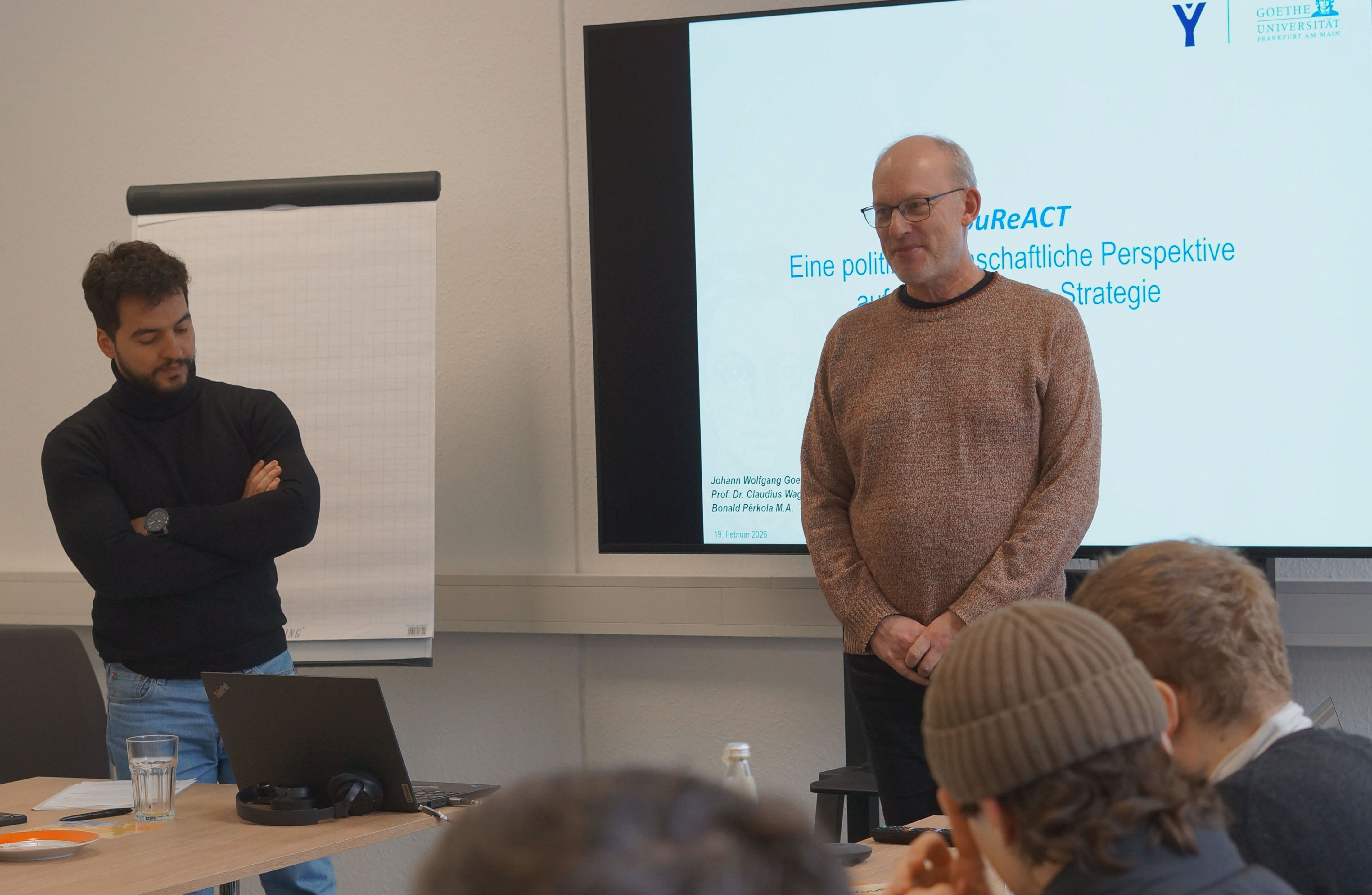
The INTERFACED consortium's Frankfurt team Anna Geyer, Noah Weber and Claudius Wagemann, responsible for Work Package 7, has submitted its latest report, Deliverable D7.3. Building on the mobilisations identified in D7.2, the report examines how far the demands of mobilisations that are sceptical towards democracy and/or science are taken up by political parties in six countries: Austria, Germany, Italy, Romania, Tunisia and the United Kingdom. Drawing on case studies by country experts across the consortium, it marks a further milestone in the project's comparative work.
Key Findings and Focus Areas
The report codes 190 demands raised by 30 mobilisations since the onset of the COVID-19 pandemic and compares them with the positions their political allies set out in election manifestos. Healthcare, anti-elitism, democracy and immigration emerge as the most prominent issues. Most demands target national governments or parliaments and call for a change of the status quo. Around two in five demands are sceptical of liberal democracy or of scientific expertise on societal issues such as migration and gender. The overlap between protest demands and party positions is generally high: in 62% of the demand-position pairs, parties take up the mobilisations' demands. Anti-ecology, anti-migration and anti-democracy demands are particularly well represented.
Comparative Analysis and Future Directions
By systematically comparing demands and party positions across very different political contexts, the report offers new insights into the links between protest and institutional politics. It also reflects on the limits of interpreting such overlaps as genuine party responsiveness, setting the stage for a closer look at how institutions react to these movements.
About INTERFACED
Started in January 2025, the INTERFACED project is a collaborative effort to understand and address the "interfacing" between political participants and authority actors. The submission of D7.3 underscores the project's productivity and its commitment to delivering timely, evidence-based research.
Next Steps
The next deliverable of Work Package 7, D7.4, will build on these findings by analysing how the political allies represent the mobilisations' demands in political institutions.
Wir freuen uns bekanntzugeben, dass das Forschungsprojekt Religion
zwischen Säkularisierung und Fundamentalismus – Die (Re-)Politisierung von
Religion erfolgreich gestartet ist. Das Projekt, welches im April 2026
begonnen hat, ist ein Teilprojekt der zweiten Förderphase der RISS-Forschungsgruppe (Reconfiguration and Internalization of Social Structure) und
wird von der Deutschen Forschungsgemeinschaft (DFG) für vier Jahre gefördert.
Die Forschungsgruppe widmet sich in der zweiten Phase zunehmend den politischen
Konsequenzen von unterschiedlichen Formen gesellschaftlichen Wandels.
Im Teilprojekt wird untersucht, inwiefern lokale
Religionsgemeinschaften vor Ort auf gesellschaftlichen Wandel reagieren, und
welche sozialen und politischen Konsequenzen hieraus folgen. Dabei stehen
religiöse Organisationen besonders unter Druck, da Säkularisierung für sie
nicht nur eine Krise darstellt, sondern ihre ganze Existenz in Frage stellt. Im
Forschungsprojekt untersuchen wir daher vor allem, welche politisierten und
innovativen Reaktionen religiöse Organisationen wählen, indem sie
sich entweder dem liberal-säkularen Mainstream annähern oder sich diesem
Trend aktiv entgegenstellen und konservativ-fundamentalistische Positionen
bestärken.
Im Zuge des Projekts wird unter anderem eine nationale Befragung
lokaler religiöser Gemeinden durchgeführt. Bei dieser Befragung handelt es sich
um die erste, breit angelegte und repräsentative Befragung von Gemeinden,
Pfarreien und Kirchengemeinden in Deutschland. Durch diese Befragung wird
mithilfe des Projekts ermöglicht, die religiöse Gemeindelandschaft in
Deutschland sowie die Wirkung religiöser Akteur*innen auf Politik und
Gesellschaft zu erfassen.
Das Forschungsprojekt wird gemeinsam von Prof. Claudius Wagemann
und Prof. Sigrid Roßteutscher geleitet. Valeria Rainero, PhD, arbeitet als
Postdoktorandin, Jan Langlitz als Doktorand in dem Forschungsprojekt. Als
studentische Mitarbeiter*innen unterstützen Ben Holzkamp und Anna Cohen die
Arbeit im Projekt.
Weitere Informationen zum Projekt finden sich hier.
Die Fördermittel stammen aus dem Programm: »Hohe Qualität in Studium und Lehre, gute Rahmenbedingungen des Studiums« des Hessischen Ministeriums für Wissenschaft und Forschung, Kunst und Kultur.
Bei weiteren Fragen zum Projekt wenden Sie sich gerne per Mail an Dr. Benedikt Bender:
The INTERFACED consortium's Frankfurt team Anna Geyer, Noah Weber and Claudius Wagemann - responsible for Work Package 7 - has submitted its latest report, Deliverable D7.2, providing a comprehensive analysis of mobilisations that challenge liberal democracy and scientific expertise across seven countries (Austria, Denmark, Germany, Italy, Spain, Tunisia, and the United Kingdom) since 2020. This report marks a significant milestone as the INTERFACED project approaches its halfway point.
The report examines how public health, immigration and multiculturalism, and environmental issues have become central drivers of democracy and science-sceptic mobilisations. It reveals a troubling trend: the increasing appropriation of such movements by far-right actors, posing intensified challenges to liberal-democratic norms and institutions. Furthermore, the COVID-19 pandemic has amplified science-sceptic mobilisation in all studied countries.
By comparing mobilisations across these diverse contexts, the report offers valuable insights into the evolving landscape of political and scientific contestation. It concludes by identifying key areas for future research, setting the stage for more in-depth and comparative analysis of institutional responsiveness to these movements.
Launched in January 2025, the INTERFACED project is a collaborative effort to understand and address the “interfacing" between political participants and authority actors. The submission of D7.2 underscores the project's productivity and its commitment to delivering timely, evidence-based research.
Deliverable D7.2 will serve as a foundation for further comparative studies within the INTERFACED consortium, informing both academic discourse and policy responses to the challenges posed by democracy- and science-sceptic movements.